
What Greene County Deed Records Reveal
Land instruments across Greene County are recorded by the Clerk of Superior Court. Each deed names the parties. It gives the recording date, describes the land, and cites any source deed or plat. Instrument type matters here. A filing is not always a sale. A recorded security deed or lien is an encumbrance, not a transfer of ownership.
| Deed Type | What It Does | Common Use |
|---|---|---|
| Warranty deed | Conveys the stated interest with deed warranties | An arm's-length purchase |
| Quitclaim deed | Conveys whatever interest the grantor has, if any | Family transfers or correcting a chain |
| Security deed | Secures a debt against the described land | Mortgage financing in Georgia |
| Executor or trustee deed | Conveys through an authorized estate or trust representative | Estate and trust administration |
| Tax deed | Records a purchase following a county tax sale | Delinquent-tax proceedings |
A name inside a deed record does not prove the person still owns the parcel. Read what came later. Conveyances, assignments, releases, cancellations, liens, and plats all matter. Georgia leans heavily on the security deed, so a lender can appear in the deed records as a party without any sale taking place.
Search Fields in the Greene County Deed Index
Remote deed work in Greene County starts with the GSCCCA Real Estate Name Search. Enter names last-name first and set Greene as the county. Try initials and spelling variants too. Search each party role separately. That helps separate an acquisition from a later transfer in the deed records.
| Index control | How to use it | Why it matters |
|---|---|---|
| Party type | Choose the transfer direction being tested | Separates grantor from grantee results |
| Instrument type | Narrow to the relevant document class | Keeps deeds distinct from other filings |
| County | Select Greene, with neighboring counties only when justified | Avoids same-name matches elsewhere |
| Name and date range | Try variants, then tighten the dates | Finds older spellings and limits noise |
| Results and table controls | Adjust the display before saving the search log | Preserves enough context to reproduce the result |
The interface also shows how far its central index reaches. That span is not a promise about Greene County specifically. So a deed missing from the web index belongs in the Clerk's books or older repository routes.
For subdivision digging, the GSCCCA property search takes a county plus a required subdivision name. Optional dates narrow it further. It will not replace a street-address or PIN search.
See the Greene County Grantor Search Screen
The official GSCCCA name-search screen lays out the party, county, instrument, and date controls a searcher uses to open a chain of deed records.
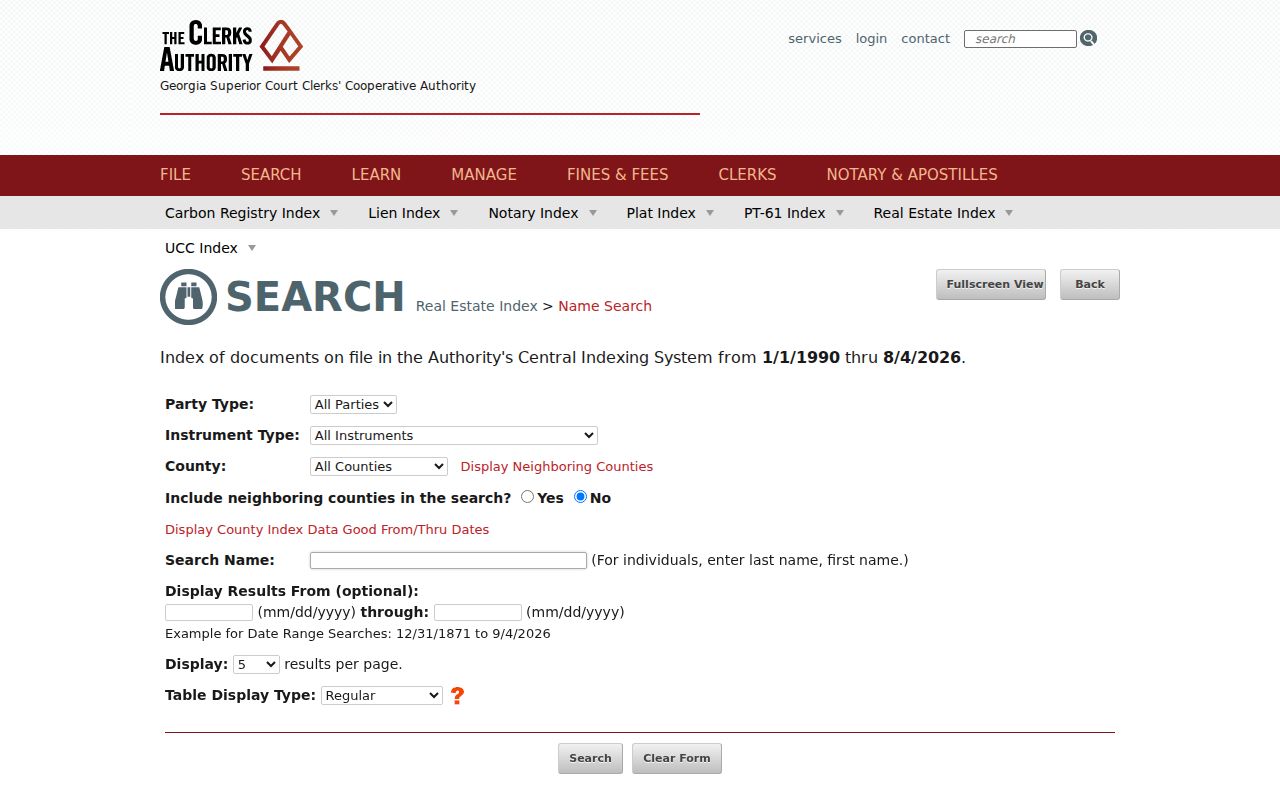
This view is only the index layer. A solid conclusion still needs the matching image, its legal description, and the next deed in line.
Follow Book, Page, Plat, and Property Clues
A deed may point to an earlier deed by book and page. It may also cite a recorded plat, a subdivision phase, or a prior legal description. Copy those references exactly. The GSCCCA book-and-page route pulls up a known citation. Its plat index searches by plat name or by book and page. A plat absent from the online index proves nothing. Participation and coverage dates vary across counties. The property-index interface shines when you already hold a formal subdivision name.
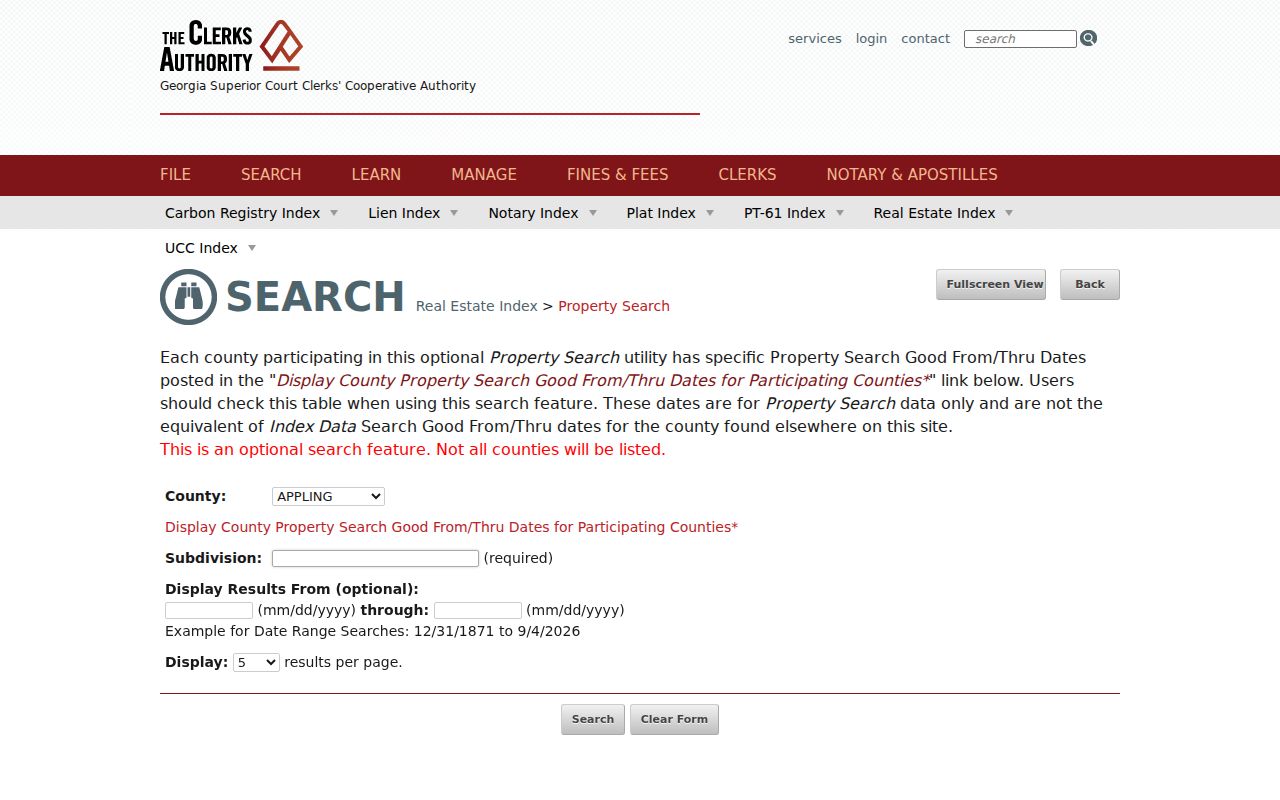
Check subdivision, unit, block, lot, and date against the deed description itself. One lake-community label may cover several formal phases and TMPs in Greene County.
Note: Keep every character in a TMP or book-page reference, since a single missing mark can point to a different tract or filing.
Trace a Greene County Grantor-Grantee Chain
Start a backward chain from the newest confirmed deed, not from the owner listed on a tax page. The grantee received the interest; the grantor conveyed it. Each cited source deed hands you the next link, but the legal description must hold steady from deed to deed.
- Find the current owner's acquisition deed with that owner indexed as grantee.
- Read the grantor, land description, deed date, recording date, and cited source deed.
- Search that grantor as an earlier grantee, then match the same tract by plat, acreage, lot, or book and page.
- Repeat until the online index ends, then carry the last confirmed reference to deed books, microfilm, or archives.
- Grantor
- The party conveying the stated interest.
- Grantee
- The party receiving the stated interest.
- Chain of title
- The sequence of instruments linking ownership of the same land through time.
- Book/page and instrument number
- Recorder references used to locate a filed document; preserve whichever reference the index supplies.
Quitclaims, corrective deeds, executor deeds, and partial-interest transfers can all bend a simple seller-to-buyer pattern. Note each party's capacity. Never join two index results on a shared name alone.
When Greene County Deeds Leave the Web
GSCCCA describes all-county material from 1999 and additions from 1993 through 1998. Its name screen shows a broader central-index range starting in 1990. Greene County publishes no stated online cutoff of its own. Treat that gap honestly rather than assuming the earliest screen date equals full local coverage.
Greene County was created in 1786. A wooden courthouse fell in 1787. A second courthouse burned in 1805. The present courthouse took shape in 1848 and 1849. Those disasters can snap a very early deed chain. The Georgia Archives Virtual Vault holds Greene County Miscellaneous Records from 1800 through 1906. The Archives finding aid points toward microfilm.
| Era or gap | Next place to check | What to retain |
|---|---|---|
| Modern indexed filing | GSCCCA and Superior Court Clerk | Party role, instrument, date, book/page, image status |
| Before reliable online coverage | Clerk deed books and county indexes | Volume, page, tract description, cited source deed |
| Historic county series | Georgia Archives microfilm and Virtual Vault | Collection, film or image number, repository note |
| Apparent early loss | Probate, tax, neighboring-county, land-lottery, and later recitals | Last confirmed instrument and exact unresolved gap |
Note: A blank link in a historic deed chain marks a research gap, not proof that no transfer ever occurred.
Greene County Filing Alerts and Deed Fraud
The GSCCCA Filing Activity Notification System sends notices when clerk-transmitted index data matches a registered name. It cannot block a filing, fix an error, or guarantee prompt delivery. Greene County offers no separate property-fraud alert of its own. Georgia identity-validation measures for title deeds and real-estate records took effect in 2025. Even so, checking deed records from time to time pays off. Open anything unexpected. Report suspected errors to the Clerk. Get legal help rather than attempting a self-help fix.
An alert is a signal. FANS depends on index data and is not guaranteed complete or current, so confirm any notice against the recorded instrument.
Separate Greene County Deeds from Liens
GSCCCA splits its land records into separate products. Real Estate holds security deeds, assignments, and cancellations. Plat, Lien, UCC, PT-61, and FANS each sit in their own index. One name search is never the whole job. Check the lien index for recorded lien categories. Treat UCC filings as a distinct personal-property system rather than part of the real-estate chain.
A payoff letter does not cancel anything. The cancellation must actually be recorded before the security deed is released. Compare the land description on every release too. A partial release or parcel substitution may affect only part of the original tract. A PT-61 or deed consideration figure is a transfer clue. It is not proof of an arm's-length market sale.
Request a Greene County Deed Copy
Copies start with the Greene County Clerk of Superior Court. The office sits at 113 N Main Street, Suite 109, Greensboro, Georgia 30642, and answers the phone at 706-453-3340. Hours run Monday through Friday, 8 a.m. to 5 p.m. Deed images are also open through GSCCCA for research. Ask staff to confirm book and page before ordering. Find out whether your intended use requires certification.
If the web image is missing, use the public counter or ask the Clerk about a mailed or electronic request. Give the office the grantor and grantee, an approximate recording date, and the instrument type. A book/page or instrument number speeds things up. Ask for a current fee quote rather than assuming an online convenience price applies.
Recorded, not guaranteed. The Greene County index shows filed instruments, not clear title, lien priority, boundary certainty, or every unrecorded interest. Obtain a qualified title examination when legal ownership matters.
Some administrative records sit outside the indexes. For those, the county Open Records Request form offers inspection or copies, with a response, timetable, or cited exception within three business days. Certified land records still go to the Superior Court Clerk.