
Greene County Owner Record
The Greene County Tax Assessor defines the fields behind the current owner record. An assessment notice identifies the recorded owner as of January 1, the account or PIN, property description, physical address, acreage, tax district, value, and any listed exemptions or credits. The owner line is useful, but its date matters. It is an assessment field tied to the annual digest, not a certificate of title.
| Recorded owner | Name used for the January 1 assessment roll |
|---|---|
| Account or PIN | Parcel identity used to hold the search together |
| Mailing address | Destination for tax and assessment notices |
| Physical address | Situs location of the land or improvement |
| Property description | Short assessor description, not the full deed description |
| Tax district | County or municipal tax context to verify |
A mailing address can sit far from the situs. Vacant tracts, second homes, trusts, and companies often use distant mailing addresses for notices. Occupancy proves nothing either. Occupants do not always hold title. Keeping both labels exactly as Greene County presents them prevents the common error of treating a mailing destination as proof that someone lives on the parcel.
Greene County Record Freshness
The qPublic access layer states that ownership information and sale dates refresh nightly. The annual assessment notice, however, describes property ownership as of January 1. Both statements can be true because a web display, the tax digest, and the recorded deed follow different clocks. Greene County research did not establish a fixed number of days between closing, clerk indexing, and every qPublic field update.
For a recent sale, note the date shown beside each source. A deed recorded after January 1 may be newer than the name printed on the assessment notice. A web refresh can also occur before an annual digest changes. The safe conclusion names the source and date instead of claiming that one owner field is instantly current.
Note: A nightly portal refresh does not promise that every newly recorded transfer appears the next morning.
Greene County Deed Vesting
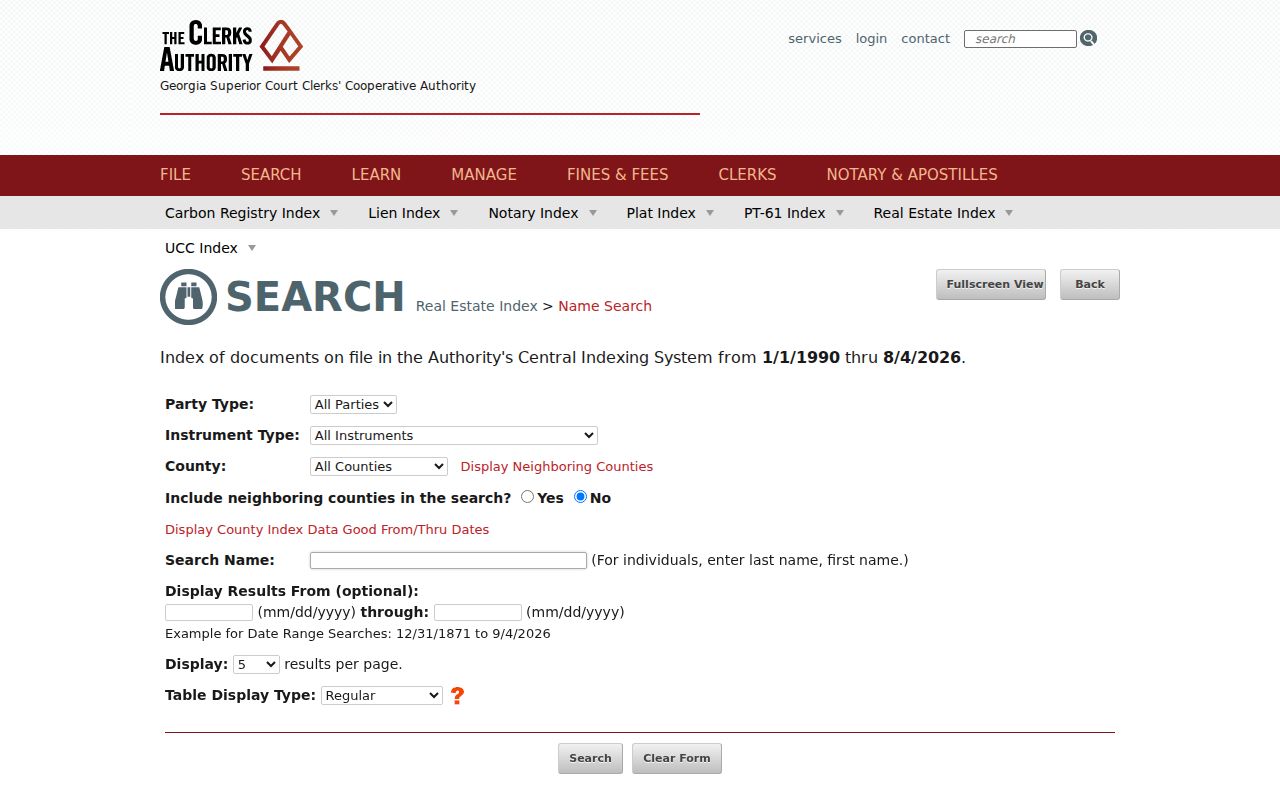
The latest deed offers the strongest vesting check. Search the GSCCCA Real Estate Name Search for the assessor name as both buyer and seller. Restrict the county to Greene. Then inspect the newest instrument on the same tract. Match the legal description, book and page, parcel clues, and source-deed recital before trusting anything. A matching name alone is weak when people or companies share similar names.
Vesting means how the deed says title is held. The index identifies parties and recording data. The image holds the granting language and exceptions. If an image is unavailable, the Greene County Clerk of Superior Court at 113 N Main Street, Suite 109, Greensboro, can supply the record by phone at 706-453-3340.
The official GSCCCA name-search screen shows the statewide grantor and grantee route used for confirmation.
Greene County Entity Owners
A Greene County owner line may name an LLC, corporation, trust, or estate. The Georgia eCorp search accepts a business name, control number, registered-agent name, or officer name. Try exact and historic entity names. Compare filing dates with the deed. The filing explains the company, not the land.
- Owner of record
- The party named in the relevant assessor or recorded source, with its date stated.
- Vesting
- The deed language describing who holds title and in what stated capacity.
- Registered agent
- A statutory contact for a business entity, not necessarily its owner or occupant.
- Situs
- The physical location assigned to the parcel, distinct from the mailing address.
Trust and estate owners call for the same restraint. A trustee, executor, or administrator may act only in a representative capacity. Probate records can explain authority, yet a will or death certificate alone never updates land title. Confirm the recorded conveyance tying estate to parcel.
Verify Greene County Current Ownership
A short, source-based check beats a full title examination. Start with parcel identity. Compare dates across records, and take any mismatch to the office that created the record.
- Locate the parcel through qPublic and save its PIN, physical address, and displayed record date.
- Read the owner of record and mailing address as separately labeled fields.
- Search that party in GSCCCA and identify the newest deed matching the parcel's legal description.
- For an LLC, compare its exact name and control number in Georgia eCorp.
- If sources conflict, ask the Assessor about the roll and the Clerk about the recorded instrument.
It verifies the public record as of stated dates. It does not resolve unrecorded claims, lien priority, forgery, boundary disputes, or competing interests. Those may need a title professional or lawyer.
Save a compact evidence packet for every conclusion. Include the qPublic result URL, access date, PIN, displayed owner, and assessment date. Add the newest deed with book and page, the legal-description match, and any entity control number. When sources disagree, state both readings and send the narrow question to the proper custodian. That packet keeps the reasoning intact. It does not lose why one record was judged newer or better tied to the land.
Greene County Address Differences
One owner inquiry can pull in three addresses. The situs address locates the property. The mailing address directs notices. A deed may rely on a legal description instead of a modern street address. Match the PIN and legal description before assuming two records describe the same tract.
Lake Oconee and Reynolds-area searches need extra care. A community name can span several phases, lots, or TMPs, and a road label is not a legal subdivision name. Richland Pointe, Del Webb, Harbor Club, and similar local names work only as search leads. The plat and parcel identifier decide the land.
ZIP codes do not settle jurisdiction. The county directory lists 30669 for both Union Point and Woodville, so check the tax district, municipal boundary, and parcel map when city authority matters.
Correcting Greene County Owner Data
A mistake in the parcel data starts with the Tax Assessor. File a roll error. Include the PIN and the source deed. Name the disputed field and the correction you want. A portal display can never amend a recorded instrument. Errors inside the deed itself belong to the Clerk of Superior Court. So do errors inside the clerk's index. A lawyer should step in where title is affected.
For administrative material that is not indexed, Greene County provides a public-records request form. Georgia's Open Records Act generally compels production within three business days. Otherwise the office must give a timetable and a legal reason for withholding. GIS datasets, permit files, and administrative records fit that route. Deeds should still go first to the Clerk and GSCCCA.
Protecting Greene County Ownership
Once the current owner is confirmed, monitoring helps. The GSCCCA FANS program sends alerts when matching filing data arrives from participating clerks. GSCCCA cautions the system is not guaranteed complete or current. It also cannot remove or correct a suspicious filing.
Georgia added identity-validation measures for title deeds and real-estate records effective January 1, 2025. Still, if an unexpected filing appears, save the index result and the deed image. Then contact the Greene County Clerk and qualified counsel. Never confront a suspected actor or attempt a self-help correction.
Practical safeguard. A filing alert works best beside periodic checks of the official index, not as a substitute for them.
Contacting a Greene County Owner
A legitimate property matter can justify using the public tax-mailing field as a contact route. Use only what is necessary. That address is not proof of residence. A registered-agent address, likewise, may serve many unrelated companies. Personal details should not be republished merely because a source displays them.
Georgia offers no one-stop removal process covering all public property records. VoteSafe shields qualifying voter residence information. It is not a blanket suppression program. Deeds, tax rolls, GIS layers, and court records stay open. A custodian redacts only when a law provides the basis.
Lawful use. Use Greene County owner information for legitimate property research. Never use it to stalk, harass, intimidate, dox, impersonate, or evade a protective order.