
Trace Greene County Former Owners
Greene County former owners come into focus through overlapping sources. Begin with the newest deed and step backward. When an index runs out, follow book-page references into paper volumes, images, microfilm, or archival holdings rather than guessing across the gap.
| Historical source | Verified time clue | Where found | Use in the chain |
|---|---|---|---|
| GSCCCA Real Estate Index | Central interface begins 1990; all-county statement begins 1999 | Online | Grantor, grantee, book and page |
| County deed books | Greene-specific online cutoff unverified | Superior Court Clerk | Earlier recorded transfers |
| Miscellaneous records | 1800-1906 | Georgia Virtual Vault | Court and land-related context |
| Historic tax and probate | Series varies | Archives and courthouse | Bridge missing deed links |
Conflicting date descriptions on the GSCCCA site do not mark a Greene County cutoff. Note the earliest local result on the record, then ask the Clerk where the older index continues.
Greene County Deed Timeline
Build a backward table. Give every transfer its own row. The grantee on the newer deed usually becomes the grantor to hunt in the prior acquisition, though fiduciary deeds, partitions, corrections, and estate transfers can break that simple pattern.
| Step backward | Name role to follow | Tract check | Evidence to save |
|---|---|---|---|
| Current transfer | Newest grantee | Full legal description | Instrument, date, book/page |
| Prior transfer | Current deed's grantor | Source-deed recital | Earlier acquisition |
| Earlier book | Prior grantee variants | Land lot, plat, calls | Book image or microfilm cite |
| Gap | Estate, tax, court parties | Acreage and adjoining land | Qualified, not assumed, link |
The timeline keeps previous owners tied to one tract. That bond holds even where the street name or modern parcel number had not yet appeared in Greene County property records.
Search Greene County Grantors
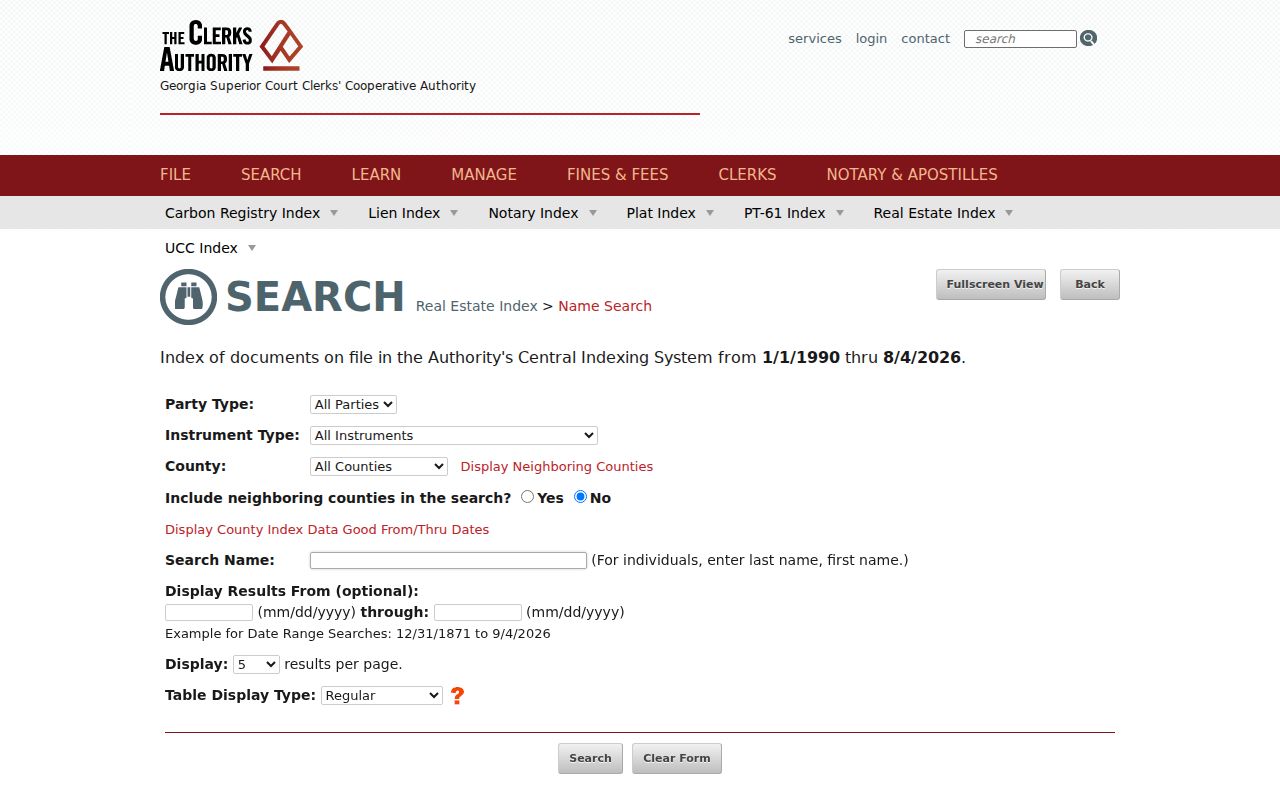
Select Greene County in the GSCCCA name search. Run the current owner of record as grantee to find an acquisition. Read the seller, then search that seller as grantee in an earlier range. Repeat with no punctuation, initials, and entity variants.
Open the instrument itself whenever possible. The legal description, source-deed recital, reservations, easements, and plat citation matter more than a shared name. Save the date range and instrument filter.
The official grantor-grantee interface is the online starting point for Greene County former owners.
Reconstruct Greene County Ownership
A disciplined chain of title follows recorded references, not a pile of names. Keep a Greene County worksheet listing instrument date, recording date, grantor, grantee, book-page, legal description, acreage, exceptions, and the cited prior deed.
- Find the newest matching acquisition with today's recorded party as grantee.
- Read its grantor and source-deed recital.
- Find that former owner as grantee in the earlier instrument.
- Confirm the tract with legal description and plat references.
- At the online edge, continue through the Clerk's deed books or archive holdings.
- Grantor
- The party conveying the stated interest.
- Grantee
- The party receiving it.
- Chain of title
- The linked sequence of transfers for the same land.
- Legal description
- The deed's land description, stronger than a changeable street address.
Mark any inference clearly when a source deed cannot be located. A later recital is a helpful lead, but it never replaces the missing original in the deed records.
Greene County Historic Plats
Subdivision plats steady a chain when road names or parcel IDs shift in Greene County. Search lot, block, unit, phase, and plat book-page in the GSCCCA Plat Index. Participating-county and operational-date limits apply. The Clerk remains the fallback.
Lake Oconee-area names demand phase detail, since Richland Pointe Village, Del Webb, Reynolds Lake Oconee, and Harbor Club can each span several plats or TMPs. A development name alone never proves two deeds concern the same lot.
Read revisions and common-area labels, not just lot lines. A replat, parcel split, road dedication, or reserved tract can reshape the modern tax roll without touching older deed language. Record the plat date and approval status. A preliminary plan is not a recorded plat.
Greene County Archive Trail
The Georgia Virtual Vault describes Greene County Miscellaneous Records. These run from 1800 through 1906. The Georgia Archives finding aid points to microfilm and county series. The Digital Library of Georgia adds historical deeds and indentures. None is a complete modern title index.
Ask at the courthouse for the next index and book. Archives reward precise notes. Preserve collection title, film or image number, volume, and page. Record the parties, date, and legal clues. FamilySearch labels may differ from county book language.
Note: A digitized image can exist without a modern name index, and an indexed volume may still lack a remote image.
Greene County Estate Transfers
Estate records can bridge a broken chain. Wills, inventories, guardianships, estate returns, partitions, and administrator deeds each carry clues. Greene County genealogy ranges point to wills from 1796 and guardianships from 1856. Probate files may name land and heirs. Yet the will alone did not record the conveyance.
Compare decedent, estate representative, land description, court order, and next deed. Search every fiduciary and heir in both roles. Tax digests can show a tract's continuity while deeds stay silent, though an assessment never proves title.
The Greene County Probate Court at 113 N Main Street, Suite 113, is the local custodian for estate and probate filings. Call ahead or visit in person to identify the file before copies are ordered. Keep probate facts and the later deed distinct.
Greene County Record Loss
Greene County was created in 1786. Its first wooden courthouse fell during an attack in 1787. A second courthouse burned in 1805. The Greek Revival courthouse standing today dates to 1848-49. That history shapes any search for former owners. A missing early transfer may simply reflect record loss, not proof that nothing happened.
Bridge the gap with several kinds of evidence. Later deed recitals, tax material, probate files, land-lottery records, newspapers, neighboring jurisdictions, and archive holdings can all help. Label the connection as inferred unless a surviving instrument proves it. The 1787 loss is a reason to investigate, never license to invent a clean chain.
Historic newspapers deserve a careful read. They can preserve old place names, estate notices, partitions, or sale dates missing from a parcel card. Search names, roads, and legal phrases separately, since optical character recognition often misreads old print. Treat a notice as discovery evidence. Confirm the event through the Clerk, Probate Court, tax office, or the recorded instrument itself.
Depth of Greene County Ownership
No verified Greene-specific earliest online deed date exists. GSCCCA publishes only broader statewide ranges. Former-owner work in Greene County eventually moves offline. The Clerk, deed books, microfilm, and archives take over from there. A chain ends at the last supported link, not automatically at county creation.
In-person access through the Clerk remains the core fallback. Archives, Virtual Vault, historic newspapers, and local history collections can then supply context or bridge evidence. A newspaper notice may suggest an estate, sale, or partition date. But the clerk or court record should confirm it.
Lawful use. Trace Greene County former owners for property history, estate research, or purchase diligence. Never use the chain to track, expose, or harass a living person.